

Preparing Commercial Rooftop HVAC Units for Winter Wind and Dust Storms in Las Cruces, NM
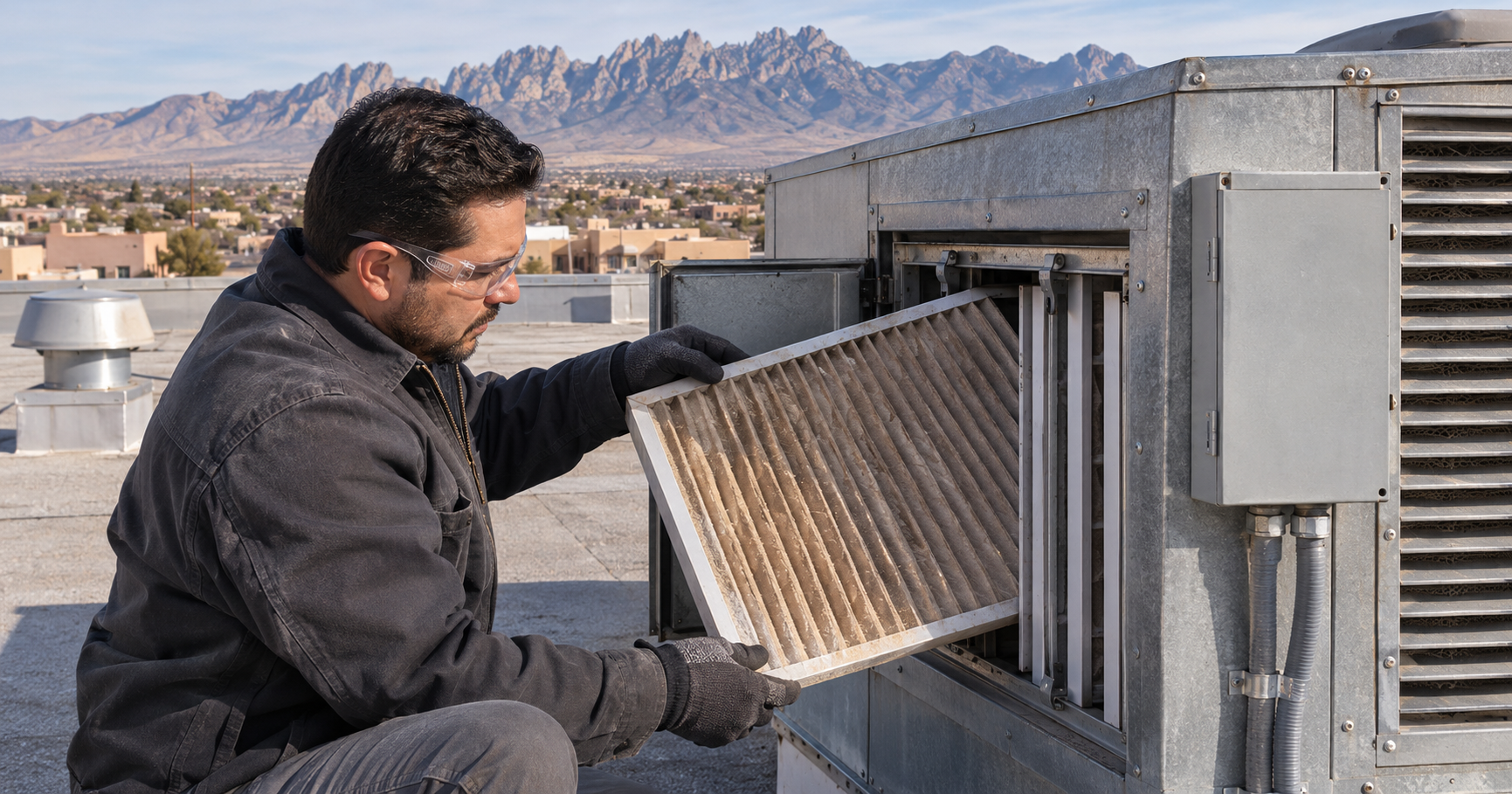
November in Las Cruces brings a familiar pairing for commercial property managers: cold fronts that pull overnight temperatures into the 20s and 30s, followed by strong winds that push Chihuahuan Desert dust across every exposed rooftop. For buildings with rooftop HVAC units, that combination is a leading reason heating systems underperform or fail when they are needed most.
Quick Answer
Commercial rooftop HVAC units in southern New Mexico need winter preparation that covers both cold-weather readiness and wind-driven dust. That means inspecting coils, filters, electrical connections, and condensate lines before the first hard freeze, then scheduling professional service before December demand builds. Standard winter checklists often overlook desert dust and the swing between mild afternoons and freezing nights.
What Commercial Property Managers in the Mesilla Valley Should Know
Rooftop units across the Mesilla Valley face dust, wind, and freeze-thaw swings that put more strain on heating equipment than a typical winter checklist assumes.
- Windblown desert dust loads filters and fouls condenser coils faster than in many other parts of the country.
- Freeze-thaw swings in Doña Ana County stress condensate drain lines and exposed refrigerant piping, especially on the flat-roof commercial buildings common in Downtown Las Cruces and along the East Mesa.
- Wind events moving through the Rio Grande valley can displace unit covers, loosen electrical conduit, and push debris into rooftop equipment.
- Coils that have not been cleaned since the cooling season carry a layer of dust that limits heat transfer, so the unit runs longer to do the same work.
- Preventative service in October or November generally costs less and disrupts tenants less than a repair call in January.
Why Winter Rooftop HVAC Prep Matters Locally
Winter prep matters in Las Cruces because desert wind, dust, and cold nights all hit rooftop equipment in the same season. At roughly 3,900 feet in elevation, the area sees overnight lows below freezing even when afternoons stay mild. Wind funneled between the Organ Mountains and the West Mesa adds more wear to units already working through that daily temperature swing.
Buildings along Telshor Boulevard, University Avenue near NMSU, and the industrial areas off Amador Avenue often run larger rooftop units with more surface exposed to wind and dust. Medical clinics, office parks, and retail centers rely on steady heat for comfort, inventory, and customer-facing operations, and a heating failure at a medical facility can become a patient safety concern.
B & H Mechanical, Inc. has provided commercial HVAC maintenance and repair across Southern New Mexico for over 30 years. We handle both commercial HVAC systems and the condensate piping connected to them, so property managers do not need to coordinate several vendors when a winter prep visit turns up related issues.
Local Data and Field Observations
Wind and dust are well documented in the region. The National Weather Service regularly issues high wind and blowing dust advisories for southern New Mexico in late fall, winter, and spring, and the New Mexico Environment Department monitors air quality in the area. Beyond that public information, the following reflects general professional observation rather than statistics. Technicians who work area rooftops commonly find visible coil fouling, overloaded filters, and sometimes debris inside unit cabinets after dust events, particularly where access panels were not latched securely.
Local Impact on Building Operations
When fouled coils or restricted airflow cut a rooftop unit’s heating capacity, the controls run longer cycles to compensate. Longer cycles raise energy use on El Paso Electric bills, add wear to compressors and heat exchangers, and shorten equipment life. In a large retail or office building with several units, that inefficiency adds up across the whole system.
Condensate drain lines that freeze during a hard Doña Ana County cold snap can back up and send water into the roof deck or ceiling tiles below. That secondary damage often costs more to repair than the original service call would have. Flat roofs with interior drains, common in local commercial construction, are especially exposed to this sequence. Downtime is the larger exposure, since a tenant without heat in January may stop operating in the space, and proactive maintenance protects both tenant relationships and the building’s income.
Warning Signs Your Rooftop HVAC Needs Attention Before Winter
Weaker heating output and fast-loading filters are the most common signs a rooftop unit needs attention before winter. Look for these:
- Heating output that is noticeably weaker than last year at the same thermostat setting
- Filters that now need changing much more often since the last major wind event
- Visible dust or debris on condenser fins or around cabinet openings
- Condensate drains that run slowly, gurgle, or show overflow staining on the roof membrane
- Control panel fault codes or warning lights that were not present last spring
- Grinding or rattling at startup that may point to loose components from wind vibration
- Refrigerant line insulation worn through by sun and wind
- Electrical conduit or disconnect covers that look shifted, loose, or poorly sealed
When to Call a Commercial HVAC Professional
Call a commercial HVAC contractor before Thanksgiving for a pre-winter inspection, or at once if any warning sign above appears. Facility staff can walk the roof, confirm access panels are latched, clear visible debris, and log unusual sounds or error codes. Those notes help the technician and should be written down.
Anything past that visual check calls for a licensed contractor. Refrigerant system inspections, coil cleaning, electrical testing at the disconnect and control board, and condensate drain checks involve equipment and licensing that go beyond facility maintenance. Commercial refrigerant work requires EPA Section 608 certification, and rooftop electrical work falls under New Mexico’s construction licensing and code requirements. Demand for commercial HVAC service across Southern New Mexico typically climbs through December, so booking in November lets you choose the timing instead of reacting to a failure.
Common Local Causes of Winter Rooftop Unit Failures
The most common causes of winter rooftop unit failures in this region are dust-fouled coils, frozen condensate lines, wind damage, skipped filter changes, and aging equipment.
Dust-fouled coils: Fine Chihuahuan Desert dust, including caliche particles, packs into condenser and evaporator fins and is the leading reason for reduced heating efficiency. Cleaning has to be done with methods that protect the fins.
Frozen or blocked condensate lines: Freeze-thaw cycles in Doña Ana County winters can freeze drain lines that ran freely all summer, especially on units with poorly sloped or unprotected drain pans.
Wind damage to electrical and refrigerant connections: Vibration from repeated wind events can loosen conduit fittings, junction box covers, and refrigerant line insulation over several seasons.
Deferred filter changes: Buildings that stretched filter intervals through the summer dust season often start winter with filtration already near its limit.
Aging equipment: Older rooftop units are closer to the end of their service life and are less able to handle the stress of a desert winter.
Prevention and Maintenance Timing for Las Cruces Commercial Properties
The best window for winter rooftop HVAC preparation is mid-October through mid-November, after summer cooling demand settles and before heating demand peaks. Technicians can work on equipment that is not under heavy load during those weeks.
A thorough winter prep visit should include:
- Coil cleaning on the condenser and evaporator sections
- Filter replacement
- Condensate drain inspection and clearing
- Electrical connection checks
- Refrigerant pressure verification
- Belt and blower inspection where applicable
- A full heating cycle test under load
Facility staff can support the visit by logging anomalies during daily rounds, keeping roof access clear and safe, and passing along any changes in tenant occupancy. After a major wind or dust event, a quick visual check of cabinet integrity and filter condition is reasonable between scheduled visits, but anything beyond that belongs to a licensed technician.
Expected Results from Professional Winter Preparation
Professional winter prep should give a building steadier temperatures, fewer emergency calls during the coldest months, and energy use that reflects a system running as designed instead of fighting restricted airflow. No visit can promise a failure-free winter, but it removes the most common causes.
Inspecting and clearing condensate systems before cold weather also lowers the chance of water intrusion, one of the more disruptive and costly winter problems in local commercial buildings. Equipment that receives consistent maintenance also tends to go longer between major repairs, which matters for rooftop units that represent significant capital investment.
Common Mistakes Commercial Property Managers Make
Property managers most often get caught by waiting, assuming, and deferring, and each mistake has a straightforward fix.
Waiting for a fault code. By the time a unit locks out in January, the building is already cold and contractor schedules are full. Book an inspection in November so issues are resolved before the first hard freeze.
Assuming summer service covered winter needs. Cooling season visits focus on refrigerant charge and cooling airflow. Winter prep checks heating components, cold-weather drain function, and electrical connections stressed by fall wind. These are different service points.
Skipping condensate lines because they ran fine in summer. Drains that move water well under summer load can freeze or back up in cold weather, particularly in exposed rooftop configurations. Clearing them before winter addresses a separate seasonal failure.
Underestimating dust events. A single dust event may not look like much, but several in a row after a summer of cooling operation add up. Assess coil condition after the dust season, not from a mid-summer record.
Common Local Scenario
This is a common scenario among commercial properties in the area, not a specific project or customer account.
A mid-size East Mesa office building with three rooftop units goes into November without scheduled HVAC service after a busy cooling season, and several October wind events go unaddressed. When temperatures drop in early December and the manager switches to heating mode, two of the three units cycle on and off without reaching setpoint. A service call finds heavily fouled coils and a frozen condensate drain on one unit with a damaged drain pan fitting. Work that would have taken a few hours in November now needs emergency scheduling, parts ordering, and repairs, leaving occupied space with reduced heat for two days. A standard fall maintenance visit would have caught all of it.
Related Service Solutions for Rooftop Systems
Our commercial HVAC services at B & H Mechanical, Inc. cover what local rooftop systems need heading into winter: coil cleaning, filter service, heating system inspection and testing, refrigerant system checks, and electrical connection verification. Because we also handle commercial plumbing and condensate piping, we can address drain lines and related rooftop piping without bringing in a second contractor.
For managers who want to move from reactive repair to planned maintenance, our preventative maintenance plans follow commercial building schedules and keep rooftop equipment documented, serviced, and ready across seasonal changes.
Comparing Your Options
Planned fall service almost always costs less and carries less risk than repairs after a failure, and a year-round maintenance plan carries the lowest risk of all.
| Approach | Timing | Cost Profile | Risk Level |
|---|---|---|---|
| Preventative fall service | October to November | Planned and predictable | Low |
| Reactive repair after failure | December to February | Emergency rates, parts availability varies | High |
| Deferred maintenance | Ongoing | Low short term, high long term | Growing over time |
| Preventative maintenance plan | Year-round scheduled | Budgetable | Lowest |
The desert wind, dust, and freeze-thaw swings put enough seasonal stress on rooftop equipment that waiting usually ends up costing more, especially when emergency work lands during the busiest weeks for contractors.
Service Areas
We serve commercial properties throughout Las Cruces and the surrounding Southern New Mexico and West Texas region, including Doña Ana County communities and facilities near the El Paso area. If your building depends on commercial rooftop HVAC equipment, we can help.
Cost of Ignoring Winter Rooftop HVAC Preparation
Skipping fall rooftop service raises operating costs and the odds of a mid-winter failure. Fouled coils reduce heat transfer and add to every El Paso Electric bill through the heating season. Frozen condensate lines can send water into ceilings, damage finishes, and displace tenants, and loose electrical connections that go unchecked can turn into equipment lockouts in the coldest weeks. For medical facilities, food service operations, and any tenant with temperature-sensitive inventory, a heating failure costs far more than the repair invoice, and prevention costs a fraction of recovery.
FAQ
How often should commercial rooftop HVAC units in Las Cruces be serviced?
Most commercial rooftop units benefit from at least two professional visits a year, one before the cooling season and one before the heating season. Desert dust and wide seasonal temperature swings in Doña Ana County create enough wear that twice-yearly maintenance is a practical minimum.
Why is dust such a problem for commercial HVAC systems in southern New Mexico?
Fine Chihuahuan Desert dust packs into coil fins and builds up inside unit cabinets, and strong wind events can load filters and foul coils quickly. That restricts airflow and heat transfer, so units work harder and use more energy until the coils are cleaned.
Can winters here actually freeze condensate drain lines on rooftop units?
Yes. Doña Ana County regularly sees overnight lows below freezing between November and February, and exposed rooftop condensate lines without adequate slope or protection can freeze during cold snaps. Freeze damage to drain pans and fittings is a common and preventable maintenance issue on commercial roofs.
What does a commercial rooftop HVAC winter preparation service include?
A thorough winter prep typically includes coil cleaning, filter replacement, condensate drain inspection and clearing, electrical connection checks, refrigerant pressure verification, heating component testing, and a full operating cycle check. The exact scope varies with unit type, age, and what the inspection turns up.
How do wind events in the Rio Grande valley affect rooftop equipment?
Strong winds can loosen conduit fittings, shift access panels, strip refrigerant line insulation, and push debris into unit cabinets. Sustained wind also drives dust through intake screens at higher speed, which speeds up coil fouling and filter loading on units across the Las Cruces area.
Do I need documented maintenance to keep equipment warranties valid?
Many equipment warranties and commercial lease or insurance terms call for documented maintenance, so check yours. A preventative maintenance plan with a licensed contractor such as B & H Mechanical, Inc. creates a service record that supports those obligations.
How early should property managers schedule winter HVAC service?
Book in October or early November. Demand for commercial HVAC service across southern New Mexico tends to rise through December, which can stretch response times. Early scheduling also leaves time to order any parts the inspection identifies before cold weather arrives.
Can B & H Mechanical handle HVAC and condensate piping issues in the same rooftop visit?
Yes. We provide both commercial HVAC and commercial plumbing, so we can address condensate drain lines, rooftop piping, and related plumbing findings during the same visit. Property managers do not need to coordinate separate contractors when a winter inspection uncovers connected issues.
Commercial rooftop systems in Las Cruces face a mix of desert dust, freeze-thaw swings, and strong wind that standard maintenance programs are not built around. Managing those risks well takes local experience, and with over 30 years of commercial mechanical work across Southern New Mexico, our team brings it to every rooftop we service.
Get Your Commercial HVAC Ready Before Winter Peaks
Scheduling rooftop service now means your building enters the heating season with equipment that has been inspected, cleaned, and tested for the conditions the Mesilla Valley actually delivers.