

Commercial Grease Trap and Drain Line Maintenance: Preventing Holiday Slowdowns for Las Cruces Restaurants
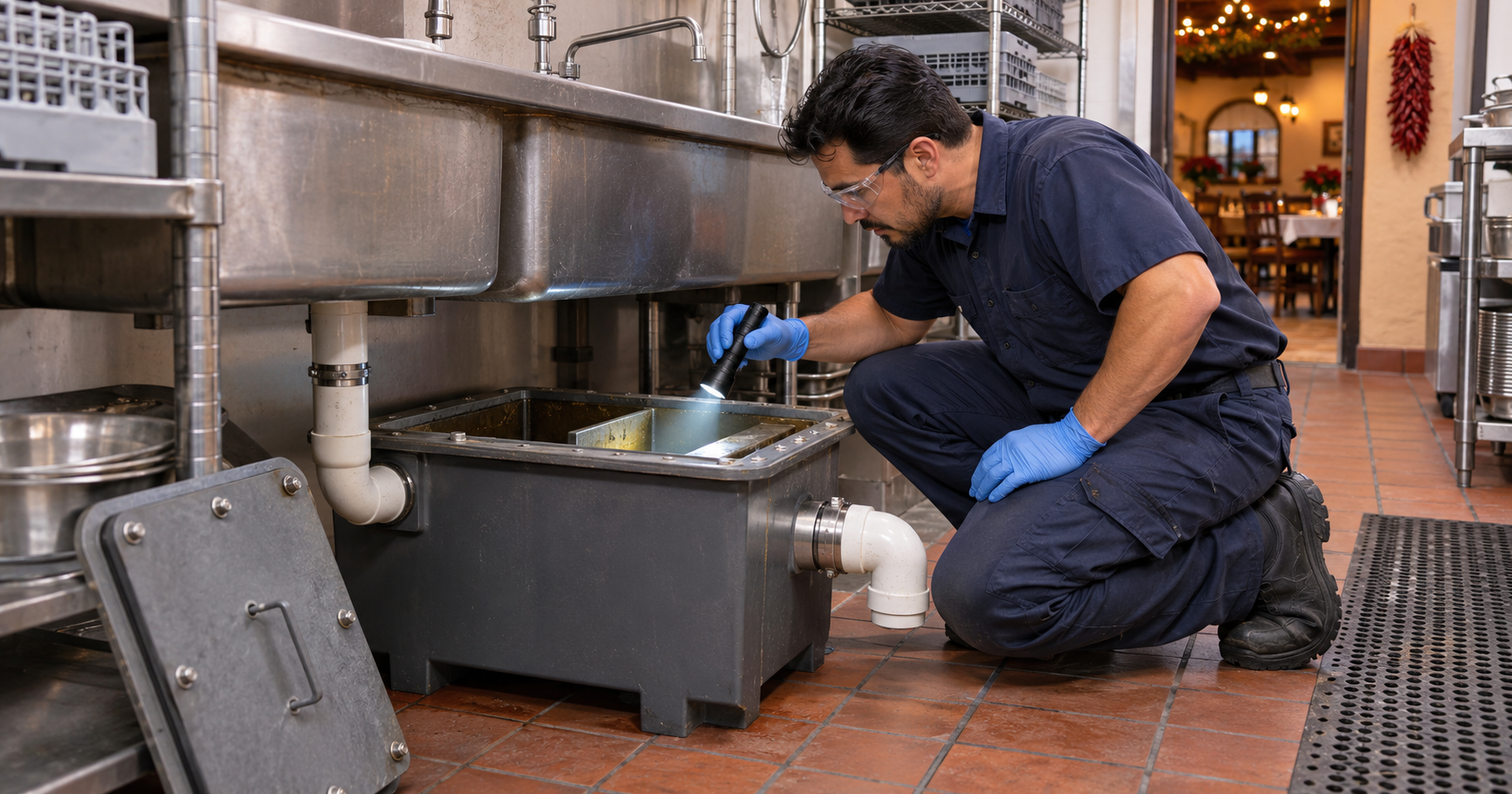
The stretch from Thanksgiving through New Year’s is the most profitable window of the year for restaurants, hotel dining rooms, and food-service operators across the Mesilla Valley. It is also when a neglected grease trap or clogged drain line can shut a kitchen down without warning. Holiday covers can run well above a normal weekday pace, and commercial kitchen plumbing has to absorb that load week after week.
Quick Answer
Commercial grease interceptors and drain lines should be inspected and serviced before holiday traffic begins, ideally in October or the first half of November. Cleaning the interceptor and hydro-jetting the kitchen drain lines removes built-up fats, oils, and grease before it forms a blockage. A scheduled maintenance routine also helps a kitchen stay in line with local wastewater requirements and avoid an emergency shutdown on its busiest nights.
What Food-Service Operators in the Mesilla Valley Should Know
Most commercial kitchens in the Mesilla Valley rely on a grease interceptor and a network of drain lines that all feed one system, so a problem in one line can quickly become a problem everywhere.
- Restaurants, hotel dining rooms, and catering kitchens along US-70 and near NMSU all send dishwashing, prep sink, and floor drain water into the same drainage system, so one blockage can back up several fixtures at once.
- Holiday catering, extended hours, and private banquet events push far more fats, oils, and grease through drain lines in one weekend than in a normal week.
- Cool overnight temperatures in Doña Ana County can cause grease to solidify in lines near exterior walls, service corridors, and underground runs.
- Older commercial strips along Lohman Avenue and in Downtown Las Cruces may have aging underground drain lines that are less forgiving of grease buildup than newer construction.
Why Grease Trap Maintenance Matters Locally
Grease trap maintenance matters in Las Cruces because winter conditions in the Chihuahuan Desert make grease harden faster in drain lines, right when kitchens are busiest. At roughly 3,900 feet in elevation, the area regularly sees overnight lows in the 20s and 30s from November through February. Grease left in a line between service periods can set up into a dense blockage faster than operators expect.
The City of Las Cruces sets requirements for fats, oils, and grease discharged into its municipal sewer system. A kitchen with a poorly maintained interceptor risks compliance problems, and a forced closure during a fully booked December weekend costs far more than a scheduled service visit.
B & H Mechanical, Inc. has served commercial properties across Southern New Mexico for over 30 years. We provide commercial plumbing and preventative maintenance planning, so we know what local kitchens face when the holiday season arrives, and we work with operators to keep their systems clear before problems develop.
Local Data and Field Observations
Field observations are the best guide here, because we are not citing published municipal statistics. In commercial plumbing work, kitchens that skip pre-holiday interceptor service are more likely to see a mid-service drain backup during peak months. The pattern holds across restaurant types, and it is most common in kitchens where a single main grease line serves several prep stations and dishwashing units. Facilities on a scheduled cleaning and inspection cycle generally have fewer emergency drain calls than those that only react to problems.
Local Impact on Restaurants and Food-Service Facilities
A drain backup during dinner service hits the whole kitchen, not just one station. A blocked main line usually shows up at floor drains first and then at prep sinks, which creates a sanitation problem that can require closing the kitchen until the line is cleared and the area is cleaned. Operators can then end up turning away guests, issuing refunds, and answering to the New Mexico Environment Department, which oversees food-service sanitation in the state.
Hotel and hospitality kitchens face the same risk at a larger scale. A banquet kitchen serving hundreds of covers in one evening sends a heavy load of grease through its lines, and an overfull interceptor cannot keep up. Standing water from a blocked floor drain also creates a slip hazard for kitchen staff, which adds liability for operators and property managers.
Warning Signs Your Grease Lines Need Service Now
Slow floor drains and persistent kitchen odors are the clearest signs that grease lines need service before the next busy weekend. Watch for these:
- Floor drains that drain slowly or pool water after busy service periods
- A sewer or sulfur odor in the kitchen or dishwashing area that returns after cleaning
- Visible grease around floor drain covers or clean-out access points
- An interceptor that has gone more than 90 days without professional service under high-volume operation
- Several sinks or drains backing up at the same time, which points to a main line blockage
- Odors venting from the interceptor lid into the service area
- A past drain inspection that found buildup but never led to a follow-up schedule
- Longer hours, new menu items, or added catering volume since the last service visit
When to Call a Commercial Plumber
Operators should call a commercial plumber as soon as any warning sign appears, when the service log shows a missed interval, or as a standard step in a pre-holiday checklist before the second week of November. Staff can safely watch how quickly drains clear after service, look at accessible cover areas for surface grease, and keep a dated service log.
Clearing a main commercial drain line, opening an interceptor, or tracing slow drains across multiple fixtures should be left to professionals. In Las Cruces, interceptor tanks are often buried under parking areas or service alleys, so access takes the right equipment and knowledge of the building’s layout. Store-bought chemical openers do not break up commercial-grade grease and can damage pipe joints and gaskets.
Common Local Causes of Grease Trap and Drain Line Problems
The most common causes of grease line problems in Las Cruces kitchens are unadjusted service intervals, cold overnight temperatures, aging pipes, and habits inside the kitchen.
Holiday volume without a new service schedule: Interceptors are usually serviced based on average daily volume. When a restaurant adds holiday hours, catering contracts, or private dining bookings, grease enters the system faster and the interceptor fills sooner than the calendar expects.
Cold overnight temperatures: Late fall and winter swings in the Chihuahuan Desert chill drain lines in exterior walls, uninsulated corridors, and underground runs. Grease can partially harden overnight and leave a coating on pipe walls that builds layer by layer.
Aging drain infrastructure: Older restaurant corridors and strip centers around the city may have smaller lines, older pipe materials, and interceptor sizing that no longer match a modern kitchen’s workload.
Food solids and fats entering drains: During service rushes, food scraps, coffee grounds, and fatty byproducts reach the drains, and the load on the interceptor grows with every shift.
Deferred maintenance: A service call pushed back a few weeks may cause no visible issue in a slow month. During holiday volume, it often does.
Prevention and Maintenance for Southern New Mexico Kitchens
The best prevention for Las Cruces commercial kitchens is a maintenance schedule based on actual operating volume, not a generic calendar date. High-volume kitchens may need quarterly interceptor service and hydro-jetting instead of a twice-yearly visit.
Before the holidays, operators should:
- Schedule an interceptor inspection and cleanout in October or the first two weeks of November, before bookings fill the calendar
- Ask a commercial plumber to hydro-jet the main kitchen lines or run a camera inspection to clear buildup from summer and fall
- Remind kitchen staff what should never go down floor drains or prep sink drains
- Make sure interceptor access covers are secure, reachable, and not blocked by equipment or storage
- Keep service records current, with the date and scope of the last professional visit
A January follow-up inspection shows how the system handled peak volume and lets the operator reset service intervals for the year ahead.
Expected Results from Professional Grease Trap and Drain Line Service
After a professional interceptor cleanout and hydro-jetting, drain lines should flow at full capacity, floor drains should clear quickly, and the interceptor should work within its designed holding capacity. Kitchens that had fallen behind on service often notice better drain performance after the first visit.
Hydro-jetting uses high-pressure water to cut grease off pipe walls and flush it out, which reaches buildup that mechanical snaking leaves behind. A single pre-holiday visit gives a kitchen a strong starting position, but it does not replace a year-round maintenance plan.
Common Mistakes Kitchen Operators Make
Most grease line emergencies come from a few repeated mistakes, and each one has a simple fix.
Waiting for a visible backup. The first sign of trouble then becomes a full backup during service. Schedule service ahead of time and track intervals in a log.
Assuming a slow drain will fix itself. A slow drain means buildup is restricting flow, and the restriction usually grows until the line blocks. Call for an inspection at the first sign of reduced flow.
Using chemical openers on grease. Residential-style products do not dissolve heavy commercial grease and can damage fittings and gaskets. Hydro-jetting by a commercial plumber physically removes the blockage.
Servicing on a fixed calendar regardless of volume. A twice-yearly schedule may suit a small café but fall short for a full-service restaurant with extended holiday hours. Match service frequency to the grease load and review it after any big change.
Ignoring floor drains and secondary lines. Operators often focus on the interceptor and skip floor drain traps, prep sink branch lines, and dishwasher connections. A complete inspection covers every kitchen drain point.
Common Local Scenario
This is a common scenario for commercial kitchens in the area, not a specific project or customer account.
A mid-size restaurant in a Las Cruces strip center books its private dining room for three December weekends and roughly doubles its normal weekend covers. Floor drains pool slightly after the first event, and the team blames the volume and keeps going. By the second event, the main drain line backs up at several floor drains during peak dinner service and forces a partial kitchen shutdown. The interceptor, last serviced in spring, is well over capacity, so emergency service is needed on a weekend evening and the dining room is delayed. A pre-season visit in October would have flagged the capacity problem and allowed the schedule to be adjusted before the first event.
Related Service Solutions for Commercial Kitchens
Our commercial plumbing services at B & H Mechanical, Inc. fit the demands of food-service and hospitality operations in Las Cruces and Southern New Mexico. We provide grease trap and grease interceptor service, commercial drain cleaning, hydro-jetting, drain camera inspections, and preventative maintenance planning for commercial kitchens, hotel facilities, and multi-tenant properties.
For operators who want steady protection instead of emergency calls, our preventative maintenance plans set a service schedule that reflects the kitchen’s real workload, with each visit inspected, cleaned, and documented.
Comparing Your Options
For most restaurants running extended holiday hours, a scheduled preventative maintenance plan carries the lowest risk of unplanned downtime, while reactive service carries the highest.
| Approach | What It Involves | Best For | Risk |
|---|---|---|---|
| Reactive service only | Calling when a problem appears | Low-volume kitchens with simple systems | High risk of an emergency during peak service |
| Pre-season single visit | One professional cleanout before the holidays | Operators with limited budget flexibility | Moderate, with no ongoing coverage |
| Preventative maintenance plan | Regular inspections, hydro-jetting, and documentation | High-volume restaurants and hospitality facilities | Lowest risk of unplanned downtime |
| DIY chemical treatments | Store-bought drain products | Not recommended for commercial kitchens | Pipe damage risk and little effect on heavy grease |
Service Areas
We serve commercial properties throughout Las Cruces and the surrounding region, including Doña Ana County, Sunland Park, Anthony, and the broader El Paso area along the border. We work with restaurants, hotels, retail properties, and other commercial facilities of all sizes.
Cost of Ignoring Grease Trap Maintenance
Putting off grease trap service through the holiday season costs more than the visit would have, and the cost comes at the worst possible moment. An emergency drain call during a holiday dinner service is priced higher than a scheduled visit and lands when staff, guests, and revenue are all at stake. A discharge event can also bring attention from local wastewater and sanitation authorities, which adds inspections and corrective steps that outlast the original incident. For a restaurant that earns much of its year in December, losing even part of that window to a preventable failure is a real financial hit.
FAQ
How often should a Las Cruces restaurant have its grease trap serviced?
Most commercial kitchens should service the interceptor at least quarterly, and high-volume kitchens need more frequent service during peak seasons. City requirements set the baseline, but the right frequency depends on operating volume and the interceptor’s rated capacity.
What is hydro-jetting, and why is it better than snaking for commercial kitchen drains?
Hydro-jetting uses high-pressure water to clean the full interior wall of a drain pipe, while snaking mostly bores a path through the center of a blockage. For grease lines, jetting removes the layered coating that causes repeat clogs and gives a more complete cleaning.
Does Las Cruces have rules about grease trap maintenance for restaurants?
Yes. The City of Las Cruces regulates fats, oils, and grease discharged into its sewer system, and commercial kitchens are expected to keep interceptors working properly. Dated service records help show compliance, so operators should confirm current requirements with the city and keep documentation on file.
Can a drain backup in my kitchen cause a health code problem?
Yes. A backup that surfaces at floor drains or prep sinks creates unsanitary conditions, and the kitchen generally has to close until the line is cleared and the area is sanitized. The New Mexico Environment Department oversees food-service sanitation and may follow up after a plumbing incident.
Why do Mesilla Valley kitchens seem to have more grease line problems in winter?
Holiday volume rises just as overnight temperatures drop, so grease entering the lines cools and hardens faster in pipes exposed to cold air. That speeds up buildup compared to warmer months, which makes pre-season service especially valuable for Doña Ana County kitchens.
How long does a commercial grease trap service take?
Time depends on the interceptor’s size, how much grease has built up, and whether hydro-jetting is included. A standard cleanout and inspection can often be finished before morning prep begins when it is scheduled in advance with a commercial plumber.
What records should I keep to show my kitchen is in compliance?
Keep dated records for every interceptor cleanout and drain line service, including who performed the work, what was done, and any observations from the inspection. These records support your position if the city asks for documentation of your grease control practices.
Should I worry about grease trap compliance if I lease my restaurant space?
Yes. Compliance applies to the food-service operation, whether the space is owned or leased. Confirm with your landlord who handles interceptor access and maintenance, and document every service visit so responsibility is clear if a problem arises.
Can B & H Mechanical service my grease trap and drain lines on a schedule?
Yes. Our preventative maintenance plans are built for food-service and hospitality operations and can match your operating volume. We provide grease trap service, hydro-jetting, and drain inspections for Las Cruces and the surrounding Doña Ana County area.
Preparing a commercial kitchen for the holidays takes more than stocking the walk-in and hiring seasonal staff. The plumbing behind your busiest days deserves the same attention, and the right time to give it is before the bookings fill in. With over 30 years of commercial work across Southern New Mexico, our team knows what local kitchens face and how to keep them running.
Keep Your Kitchen Running Clean Through the Holiday Rush
Our commercial plumbing team is ready to inspect, clean, and document your system before your busiest weeks arrive.